Before you change the culture, see the one you already have
A culture is rarely what the wall says it is - it is the quieter thing people learn by working here: what is safe to say, whose mistakes are forgiven, and what gets rewarded, whatever the values say.
What's hardest to see
A culture change effort starts from a picture of the culture, and that picture is usually the stated one - the values agreed in a room, the version that is easiest to agree on. The lived culture, how it feels to work here day to day, is harder to see, and it is the one the change has to move.
The other hard part is that there is no single culture to change. What feels safe and fair in one team can feel like the opposite two floors down or a region away. A whole-organisation average smooths those differences flat, and it is often the pockets that differ most - where the gap between stated and lived runs widest - that decide whether the change takes.
of executives say they struggle to build a high-performance culture.
Most leaders don't end up with the culture they set out to build - all the more reason to read the one you have first.
What States of Vitality shows you
We take one short, anonymous read across the whole workforce and show you the lived culture - not the version on the wall, but how it feels on the ground. Culture is one of eight connected dimensions, scored and ranked, and it opens into the facets that shape how a culture feels day to day: whether stated values match what people experience, whether it feels safe to speak up, whether mistakes are met with learning rather than blame, whether people feel respect and belonging, and whether what gets rewarded matches what gets said.
Because it is broken down by group, you see that culture is not one thing - where it already supports the change you have in mind, and where it works against it. You see which teams, levels and locations report the smallest gap between stated and lived and which the widest, where people broadly agree and where they read the same place very differently, and how far the view from the top sits from the experience on the front line.
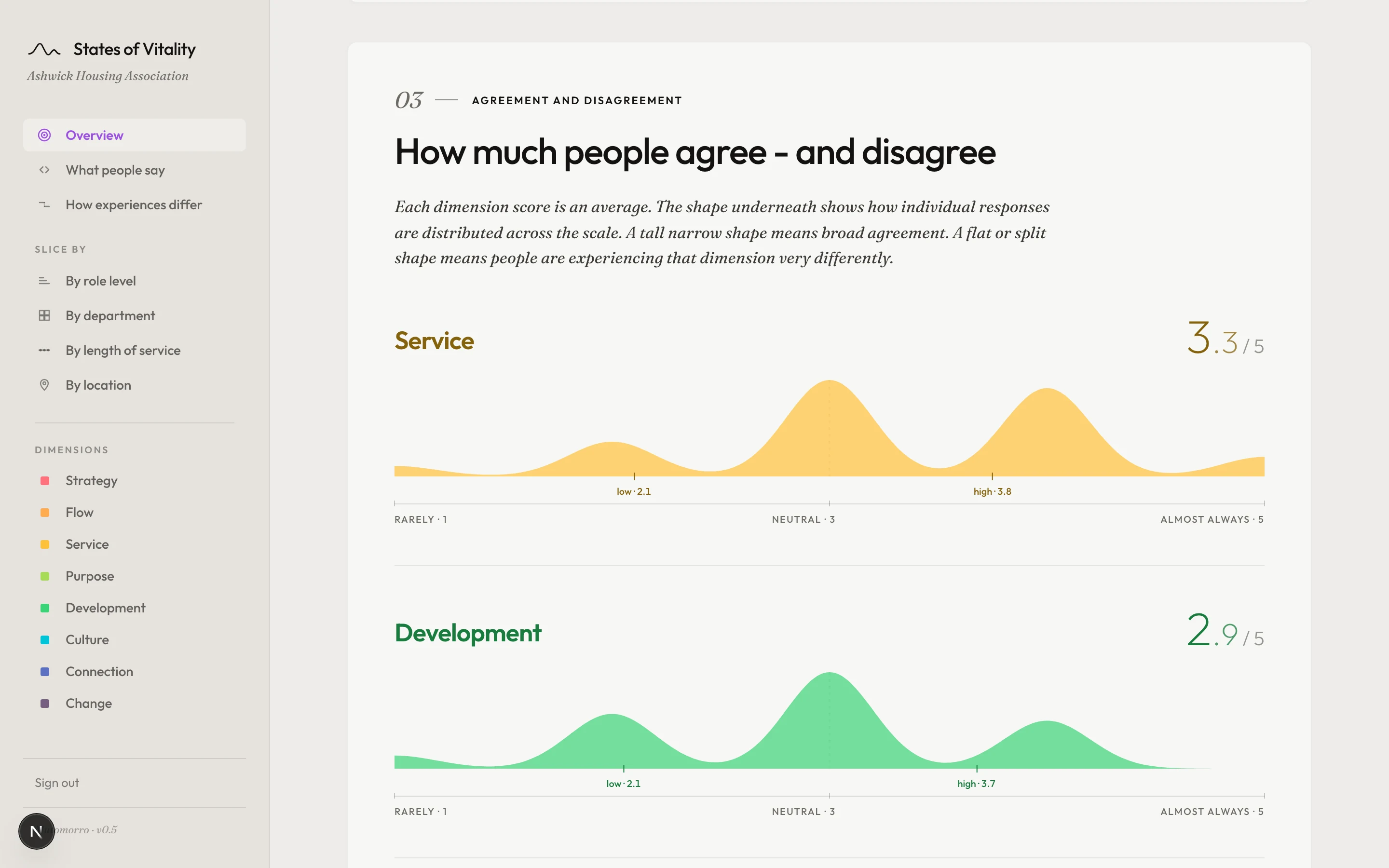
What you'd see in the dashboard
Compare any two groups - department, level, tenure, location - side by side, on a link you can share, to see how differently the culture is experienced across them.
A heatmap of every group against every area, so you can see that culture is not one thing - and where the lived experience varies most sharply across the organisation.
Where people broadly agree on how it feels here, and where they see the same place very differently - the divides a single culture story tends to hide.
What people wrote themselves about how it feels to work here, filtered by group and read directly rather than summarised away.
About to change the culture?
We can talk through what a read of the lived culture would look like before you begin - scope, timing and price.