You have the customer metrics. What shapes them is internal.
A customer never meets your strategy or your structure - they meet the downstream of both, in a single moment with one person at the front. What reaches them is shaped long before that, by conditions they never see: how work flows, whether the front line is supported, whether the voice of the people you serve ever reaches the decisions that affect them.
What's hardest to see
Customer metrics tell you the result clearly. What they cannot tell you is what produced it - and the levers that move it sit inside the organisation, upstream of the moment a customer is ever met. A score can dip without naming the snagged handoff, the front line stretched too thin to do the work justice, or the problem that keeps being patched rather than fixed at the cause.
The harder part is that the signal runs the wrong way. The people closest to customers see the friction first, but their read has the furthest to travel to reach the decisions that could ease it. By the time it shows in the numbers, the conditions that caused it have usually been in place for a while.
of customer contacts are "failure demand" - demand created by failing to do something, or to do it right, for the customer.
Much of what reaches the customer isn't real demand at all - it's the organisation's own internal failure, arriving as a complaint or a call.
What States of Vitality shows you
We take one short, anonymous read across the whole workforce and show you the internal conditions that shape what your customers meet - not the customer experience itself, but the dynamics upstream of it. Service is one of eight connected dimensions, scored and ranked, and it opens into the facets that decide what reaches the front line: whether what you deliver is improving, whether the work is built around real need, whether the voice of the people you serve reaches the decisions that affect them, whether problems get fixed at the cause rather than the symptom, and whether there is room to improve rather than only keep up.
Service does not stand alone. You see it beside Flow - whether handoffs snag before they reach a customer; Connection - whether the front line's signal reaches the people deciding; and Development - whether the people serving are supported or used up. Because it is broken down by group, you see how the front line's read differs from the rest, and how far the view from the top sits from the front line's read of where the work meets the customer.
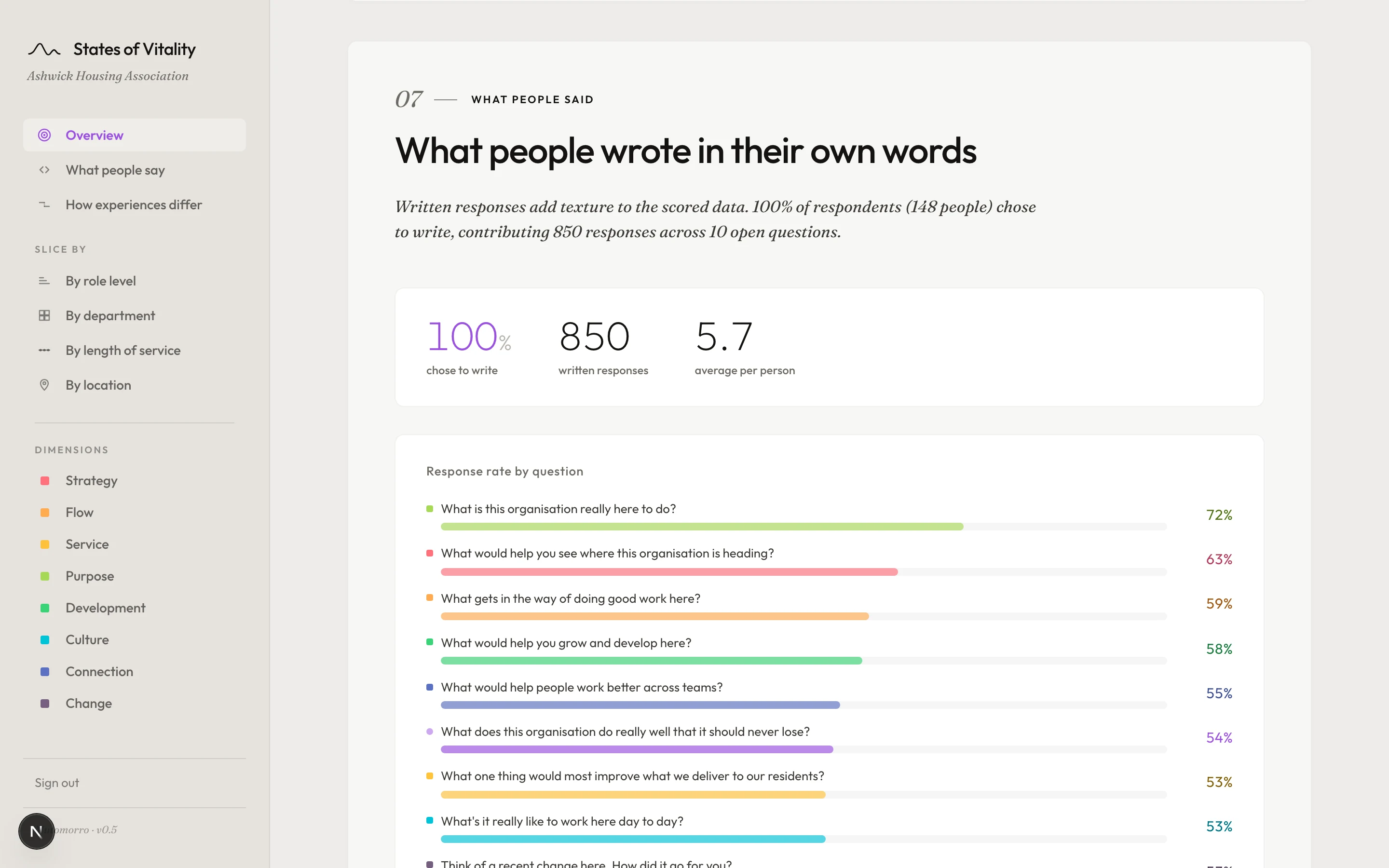
What you'd see in the dashboard
Every dimension scored and ranked, with Service, Flow, Connection and Development in their place among them, so you can see at a glance which internal conditions are carrying the customer-facing work and which are straining it.
Open the Service score to see how its five questions vary underneath it - whether what you deliver is improving, whether the work is built around real need, whether the voice of the people you serve reaches the decisions that affect them, and whether problems get fixed at the cause.
The view from the top set against the view from the front line - so the read of the conditions shaping what your customers meet is not the leadership view alone, but the account of the people closest to them.
What the front line wrote themselves about serving under pressure - filtered by group and read directly, the people closest to customers in their own voice rather than summarised away.
Want to see what your customer metrics sit on top of?
We can talk through what a read of the internal conditions that shape what your customers meet would look like - scope, timing and price.