You have the engagement score. Now see what shapes it.
An engagement score is a reading - a single number for how people feel about working here. It tells you the temperature without telling you the weather: the conditions, underneath, that quietly decide whether the work is something people can do well, grow in and believe in.
What's hardest to see
An engagement survey is good at the result and quiet on the cause. It tells you how people feel, and how that has moved since last time, but not what is producing the feeling - whether people can do good work without fighting the system, whether they are growing or being used up, whether it feels safe to speak, whether they are in the loop, whether the work means anything. Those are what the number sits on top of.
The harder part is that the experience is rarely one thing. A single figure averages everyone together and smooths the differences flat, so very different experiences can meet in the middle and read as fine. What shapes the experience, and where it varies most, is the part a headline figure is built to hide.
of employees worldwide are engaged - and the figure is falling.
Decades of measuring engagement, and the number still won't move. The score was never the thing to change.
What States of Vitality shows you
We take one short, anonymous read across the whole workforce and show you the conditions that produce the experience, not just the feeling it leaves behind. The dimensions that most shape how work feels are scored and ranked alongside the rest: Flow - whether people can do good work without fighting the system; Development - whether they are growing or being used up; Culture - belonging, trust, safety and recognition; Connection - whether they are in the loop and heard; and Purpose - whether the work means something. Each is one of eight connected dimensions, so you see the experience as part of a whole, not a number on its own.
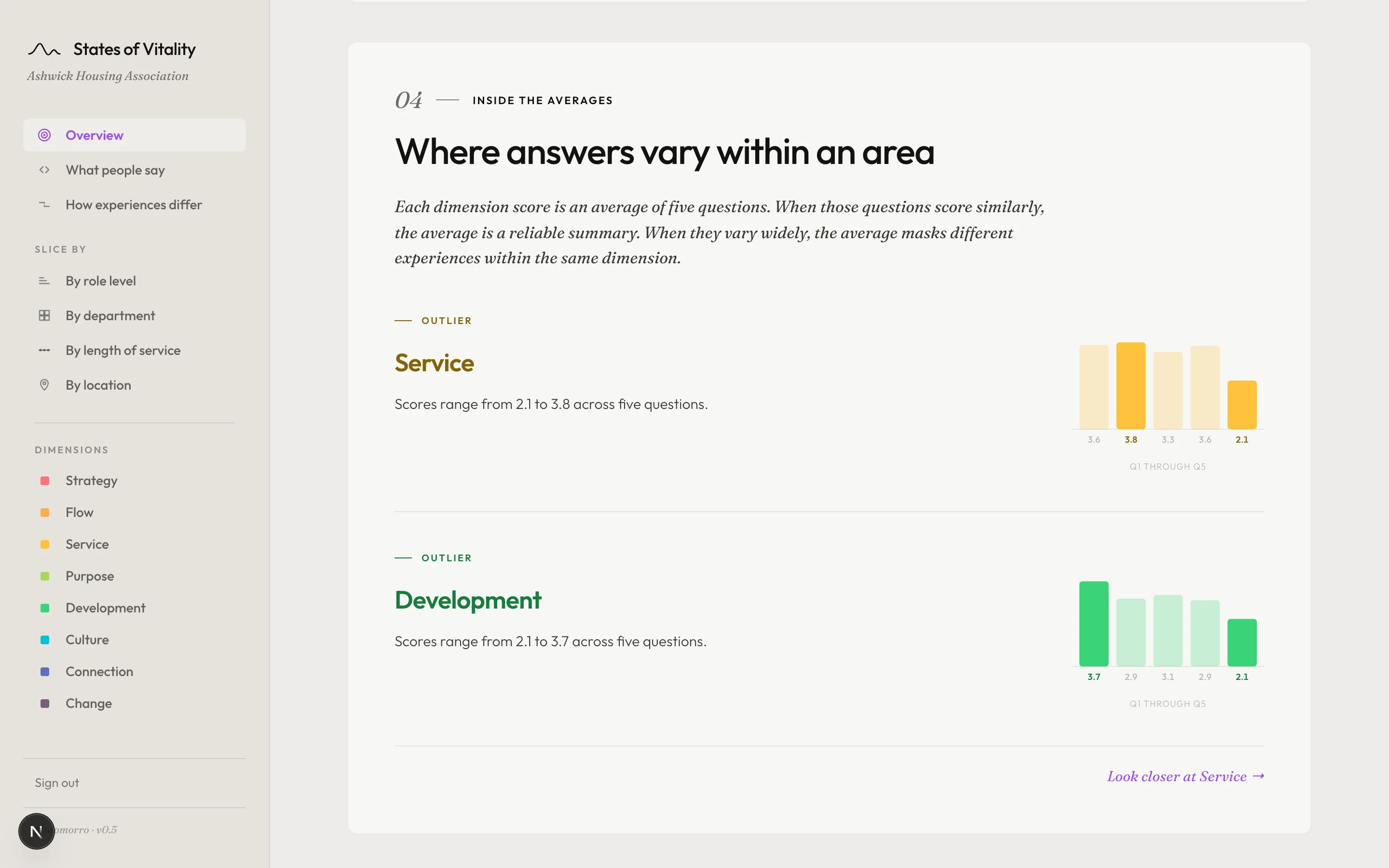
And you can open any score to see how its five questions vary underneath it - Beneath the average. A steady Culture score can sit on top of very different answers, rather than one figure standing for all of them. Because it is broken down by group, you also see where the experience differs from one part of the organisation to the next, and how the view from the top compares with the view on the front line.
What you'd see in the dashboard
Open any score to see how its five questions vary underneath it - so a calm Culture or Flow number resolves into the specific things people experience differently, rather than a single figure standing in for all of it.
Every dimension scored and ranked, with Flow, Development, Culture, Connection and Purpose in their place among them, so you can see at a glance what is carrying the experience and what is straining it.
A heatmap of every group against every area, showing where the experience varies most across the organisation.
What people wrote themselves about how it feels to work here, filtered by group and read directly rather than summarised into a score.
Have the score, and want to see what is shaping it?
We can talk through what a read of the conditions beneath your engagement number would look like - scope, timing and price.