You rolled the change out. See whether it's now how things work
A change is declared done when the work of doing it stops - which is also when attention moves on, and an organisation tends to ease back toward the defaults it knows best. Rolled out is not the same as lived.
What's hardest to see
A change is easy to track while it is happening - the launch, the training, the new system switched on. What is hard to see is what holds once the programme closes and attention moves elsewhere. Behaviour can quietly settle back to the old way while every box stays ticked, and nothing announces the reversion; the new process is still on the page, just no longer how the work is done.
The other hard part is that embedding is uneven. Some teams took the change on and made it theirs; others slipped back toward the old way once the attention moved on. A whole-organisation "it's embedded" averages those apart, so the places where it took and the places where it reverted meet in the middle and read as settled.
of major change initiatives fully meet their goals.
Most changes are declared done long before they are lived - rolled out is not the same as embedded.
What States of Vitality shows you
We take one short, anonymous read across the whole workforce and show you the current state - whether the new ways are now how things work, lived day to day, or whether they have quietly given way to the old defaults. Change is one of eight connected dimensions, scored and ranked, and it opens into the facets that decide whether a change beds in: whether change is a natural rhythm here or something endured, whether people are clear what it meant for them, whether there was support to make the shift, and whether there was enough time to settle before the next thing arrived. Beside it you see Flow - whether the new way is now how the work moves - and Culture - whether the change is lived rather than just announced.
Because it is broken down by group, you see that embedding is not one thing - which teams, levels or locations took the change on and which slipped back, where people broadly agree it has settled and where they read it very differently. If you happened to hold a read before the change, comparing the two shows what shifted and what held. On its own, this is a read of the present - where the new ways are lived now, and where the old ones returned.
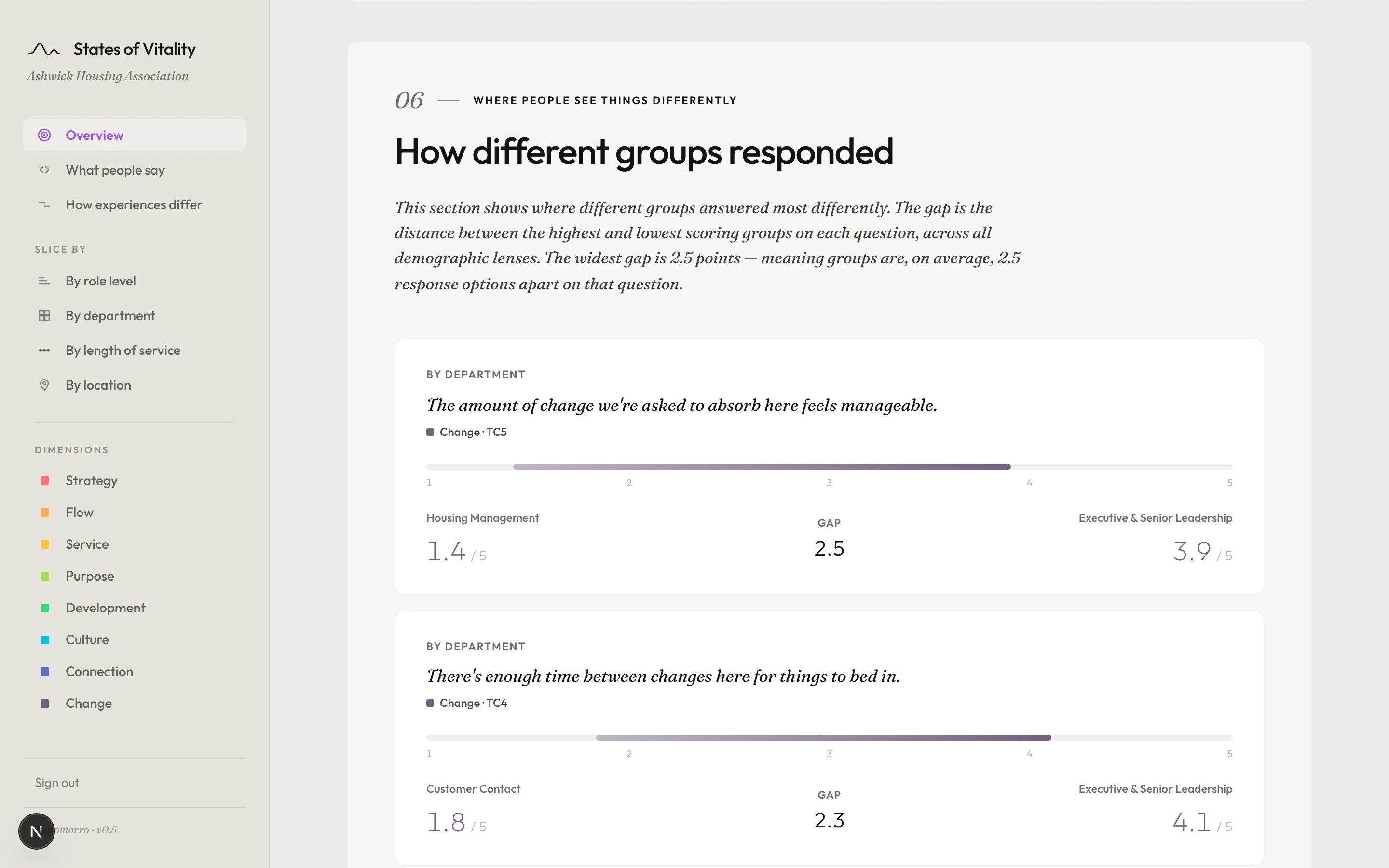
What you'd see in the dashboard
Open the Change score to see how its five questions vary underneath it - whether change is a natural rhythm here, whether people were clear what it meant for them, whether there was support and enough time to settle before the next thing arrived.
A heatmap of every group against every area, so you can see where the change took and where it reverted - the teams and places a whole-organisation "it's embedded" averages flat.
Compare any two groups - department, level, tenure, location - side by side, on a link you can share, to see which parts of the organisation made the change theirs and which slipped back.
What people wrote themselves about how the change has settled - or hasn't - filtered by group and read directly rather than summarised away.
Ran a change and want to know if it took?
We can talk through what a read of whether the new ways are lived now, and where they took versus reverted, would look like - scope, timing and price.