Your strategy is clear at the top - is it clear everywhere else?
A strategy can be sound, well-argued and signed off, and still go quiet on the way down - clearest in the room where it was written, fainter with every layer it passes through.
What's hardest to see
Strategy is easy to judge from the top, where it is whole and well-rehearsed. What is hard to see is the version that survives the journey down - how much of it reaches the front line, and how much of the meaning arrives intact.
A strategy can be word-perfect on the page and still not shape a single decision on the ground. The gap between knowing the words and acting on them rarely announces itself; it shows up later, in choices that quietly pull in different directions, long after the launch was counted a success.
of executives say their firms struggle to bridge the gap between strategy and day-to-day implementation.
The hardest part of a strategy is rarely writing it - it is the distance between the page and the day-to-day.
What States of Vitality shows you
We take one short, anonymous read across the whole workforce and show you whether the direction is shared and felt, or mainly published. Strategy is one of eight connected dimensions, scored and ranked, so you can see how clear the direction feels on the ground - whether people understand where the organisation is heading, and whether they feel their daily decisions line up with it.
Because it is broken down by group, you can see where the strategy is getting stuck - which levels, departments or locations read it the same way, and where they sharply diverge. And because it is a whole-workforce read, the perception gap is right there: how far the clarity you feel at the top sits from the clarity people have where the work is done.
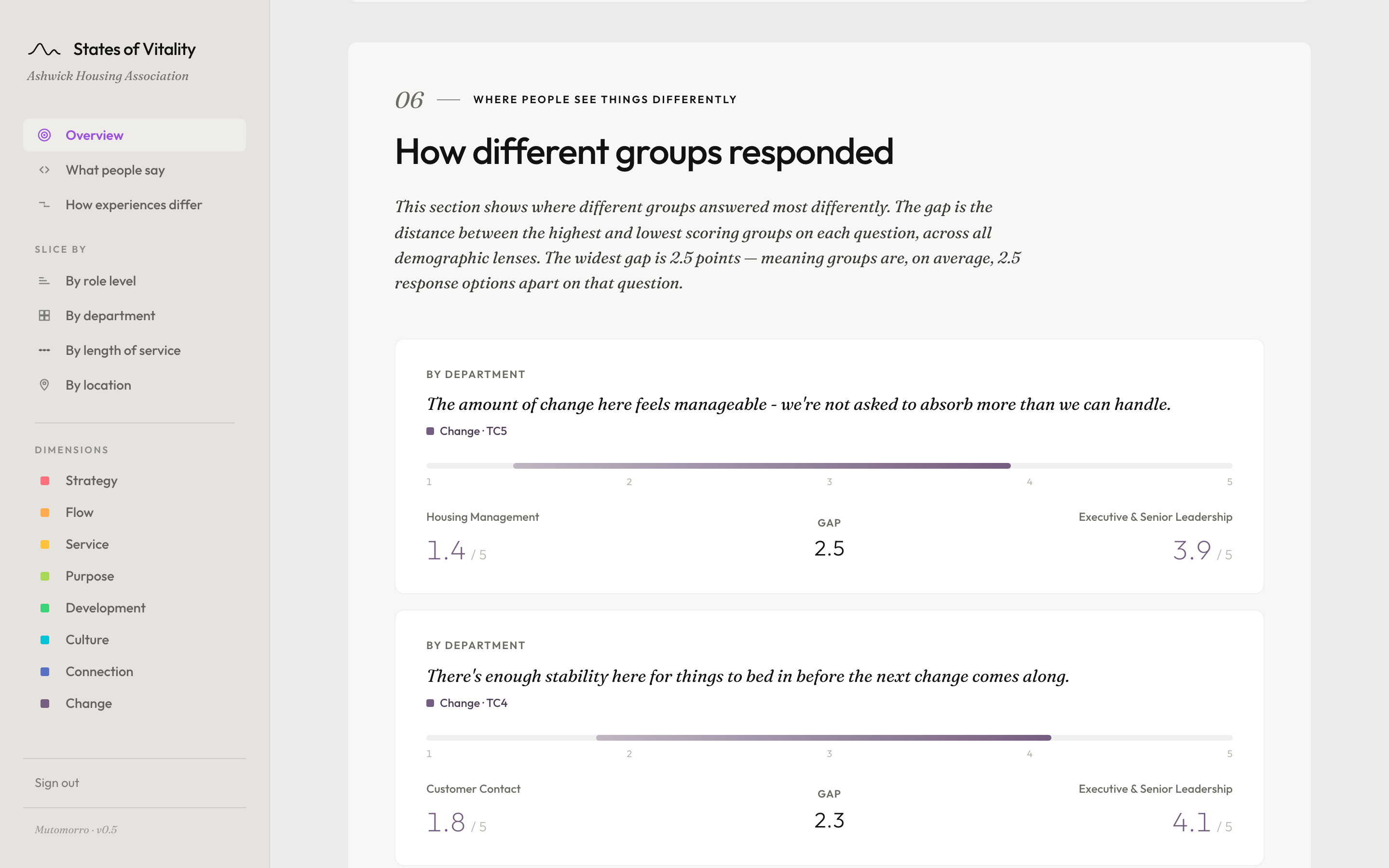
What you'd see in the dashboard
Every dimension scored and ranked, with Strategy in its place among them, so you can see at a glance how clear the direction feels against everything else.
Open the Strategy score to see how its five questions vary underneath it - separating whether people know the direction from whether they feel it shapes their decisions.
Compare any two groups - level, department, tenure, location - side by side, to see where the strategy lands and where it goes quiet, on a link you can share.
The clarity felt at the top set against the clarity on the front line, so you can see how far the strategy has travelled.
Wondering whether your strategy has landed?
We can talk through what a read of where the direction is shared, and where it fades, would look like - scope, timing and price.