
Almost every organisation tracks how its people are doing, and the figure it reaches for is usually an engagement score. That's a fair instinct - it's a real signal, and watching it is a way of paying attention to something that matters.
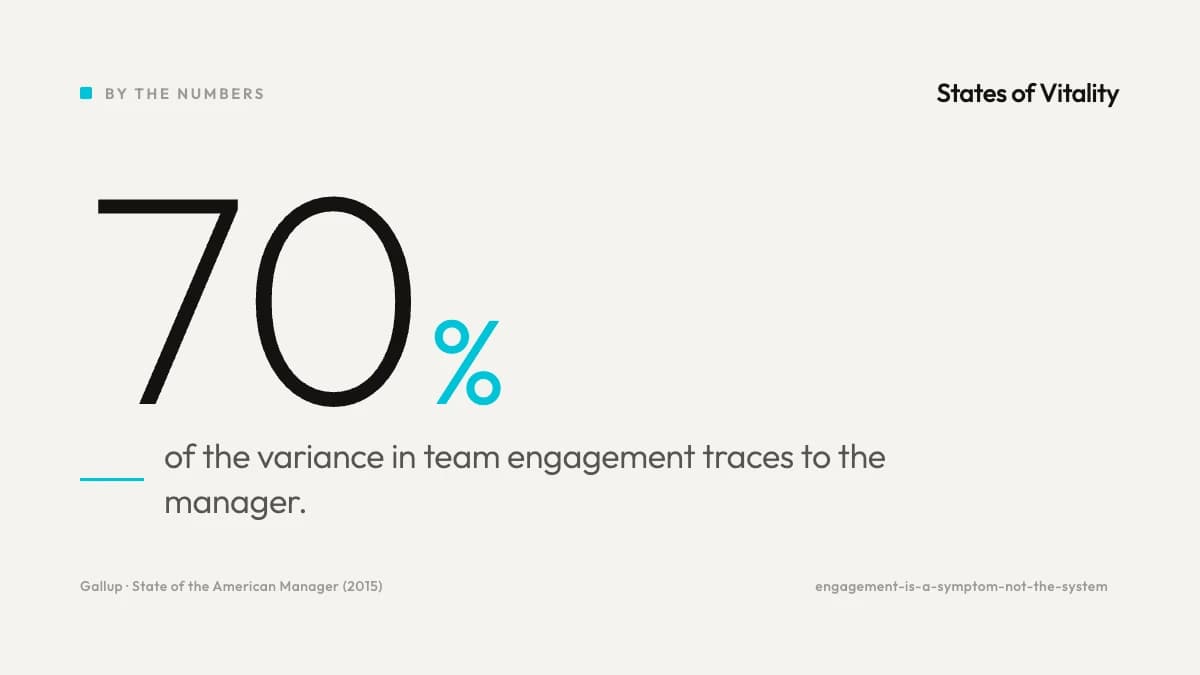
It's also a reading of something larger than itself, and there's a finding that shows how much larger. When Gallup asked why some teams inside the same organisation are far more engaged than others - same pay, same benefits, same mission statement - around 70% of the difference traced to a single thing: the manager. Not the perks, not the words on the careers page.
Sit with that and a question opens up. If most of what an engagement survey picks up isn't really about the survey, then the score is a symptom of something else. The interesting question isn't how to lift it. It's what it's a symptom of.
A symptom is not a fault
That finding is stranger than it first sounds, and it's easy to misread as a verdict on managers. It's closer to the opposite. A manager is less the source of all this than the place it gathers. Nobody invents the wider conditions they manage in. A manager sits in the middle ground between strategic intent and operational reality, holding two worlds that don't always agree and reconciling them day by day - translating a strategy someone else wrote, carrying a culture they inherited, running work that flows or jams because of decisions made in rooms they were never in. Ask why a team is disengaged and you rarely arrive at the manager and stop. You arrive at the manager, and find a dozen threads leading further back.
So when we say engagement is a symptom, the word is doing precise work. We mean it in the clean clinical sense, not the alarming one.
A symptom is not a fault. It is the system showing you where to look.
A fever isn't the illness. It's the body reporting on the illness, and it's useful precisely because it points past itself to something you can't see directly. An engagement score behaves the same way - the number is an organisation reporting on its own condition. It's at its most valuable when it sends you looking for that condition, rather than becoming the thing you set out to fix.
We've followed one half of this elsewhere - how a score gives you the temperature of a place without telling you its cause. This is the other half. A symptom of what? Of the health of the whole organisation, treated as a working system rather than a stack of separate parts - which turns out to be a more concrete idea than it sounds.
The list is the least interesting part
Across a lot of organisational work, the same handful of conditions keep proving to be the ones that shape how a place feels to work in. There are eight of them, give or take how you cut it: whether strategy is genuinely embedded or merely announced; whether work flows or stalls; whether the service an organisation exists to provide keeps evolving; whether its purpose resonates or sits in a frame by the lifts; whether it builds its own capacity to grow; whether the culture people describe matches the one they actually live; whether the stories that hold the place together still connect; and whether it stays tuned to change or braces against it.
You could read that as a checklist, and it's roughly where most assessments stop - a tidy list of factors to score, one row each. To be fair, that's already a step forward. The better engagement tools moved on from treating the score as the whole story some time ago, and started measuring its drivers instead - recognition, growth, clarity, and the rest. Looking past the number to what sits behind it is the right instinct.
But a list, however long, is the least interesting thing about a system. Lay eight conditions out in a row and what you have is a row. What gets lost is the very thing that made them a system to begin with: the connections between them.
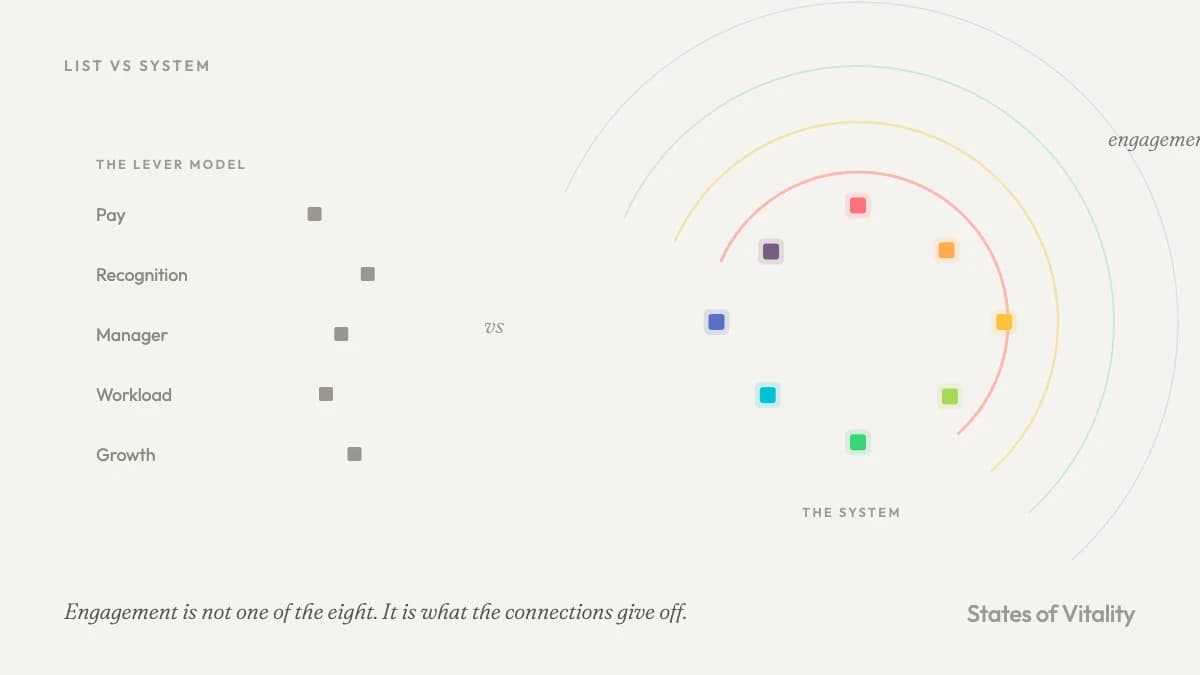
This is where the real story lives. Strategy that's clear but never embedded slowly drains the meaning out of the work - and the work is where development happens, and development is a fair part of what a culture grows from. Tug on one and the others shift. Some of those links carry far more weight than others, which is another way of saying an organisation has leverage points: places where a small, well-aimed nudge changes a great deal, and places where enormous effort changes almost nothing. And engagement - the number everyone watches - isn't really one of the eight at all. It's closer to what the whole connected arrangement gives off when it's running well, or struggling to.
The energy of a place that's genuinely working - the sense that effort goes somewhere, that people are pulling roughly the same way - doesn't sit inside any one of the eight conditions. It comes from how they meet. Which is why an organisation can have every box ticked and still feel oddly flat, and why another can be visibly short in a few places and still, somehow, hum.
When the signal and its source come apart
Here's a pattern that turns up again and again. Strategy is crisp and confident at the top of an organisation. Somewhere on the way down through the layers it thins out, until the people actually doing the work are clear enough on what to do but increasingly hazy on why it matters. The work begins to jam - nothing dramatic, just a little more friction, a few more handoffs that don't quite land, a creeping sense of effort without traction. None of it arrives wearing a label that says strategy. It shows up, months later, as a dip in one team's engagement score - often a team some distance from where the trouble started.
The manager of that team is where the strain becomes visible - not because they caused it, but because a manager is the joint a system's tensions tend to run through. You could support that manager on engagement with all the goodwill in the world and never reach the cause, which is sitting in the gap between a strategy and the flow of work two floors up.
It cuts the other way too. An organisation whose purpose genuinely lands can run warm on engagement for years while something structural is seizing up underneath, the good feeling masking the strain rather than reflecting the whole picture. A high score isn't always good news, and a low one isn't always bad news about the team it appears in. That's simply what a connected system does to the people watching it: the signal and its source come apart. The place a problem shows up is frequently nowhere near the place it's coming from.
It's why chasing a low score head-on so seldom works, and why the hunt for the one broken thing so often ends empty-handed. The cause is rarely a thing. It's usually a relationship between things.
You cannot move a number by pushing on the number
There's another reason direct pressure on engagement tends to disappoint, and it's been sitting in the research for years.
Engagement and the outcomes everyone wants - performance, retention, the rest - reliably travel together. That correlation is real and well documented, and it's tempting to read it as a lever: lift engagement, and the outcomes follow on behind. But correlation has a habit of pointing the wrong way round. Far more often, engagement and those outcomes aren't cause and effect at all. They're two things the same healthy conditions produce at the same time. They travel together because they share a source.
If that's right, then squeezing the engagement number on its own is a little like cooling the thermometer to bring down a fever. You can do it. The reading will change. The patient will be exactly as unwell.
None of which makes the number worthless - the opposite. A thermometer is a fine instrument, and you wouldn't want to be without one. It's simply not the place you intervene.
From managing a number to reading a system
The shift here is small to describe and surprisingly large to live with: the move from managing a number to reading a system.
Once engagement is one signal among several rather than the headline act, a different question opens up. Not "how do we get the score up", and not even "how do we compare against everyone else", but something more useful: what's actually going on in our particular organisation, where do its parts connect, and where would attention genuinely pay off? That's a question about your own shape, not your rank against a faceless average - a mirror, rather than a ruler.
Reading the system is its own discipline, and worth holding apart from the work of changing it. Seeing clearly comes first, and it tends to make the changing far less a matter of guesswork and far more a matter of aim. It's a steadier way to work than chasing a quarterly figure, and a kinder one - because a system you can see is a system you can afford to be patient with. The dips stop being verdicts and start being information. The work of turning a clear picture into something that moves is squarely the development side of things.
For now, the useful move is the smallest one. The next time that number lands on a desk, up a point or down two, it's worth resisting the urge to treat it as the thing to fix - and asking instead what it's been trying to show you all along.