
An engagement survey is meant to tell you where to focus. Where things are working, where to build, where to adapt. That's a fair thing to want from it. But there's a finding that complicates the picture.
Gallup has spent decades pooling engagement data across millions of teams. Inside a single company, the gap between its most and least engaged teams turns out to be nearly as wide as the gap across every company they've ever measured. Two teams down the same corridor can sit as far apart as two organisations in different industries, on different continents.
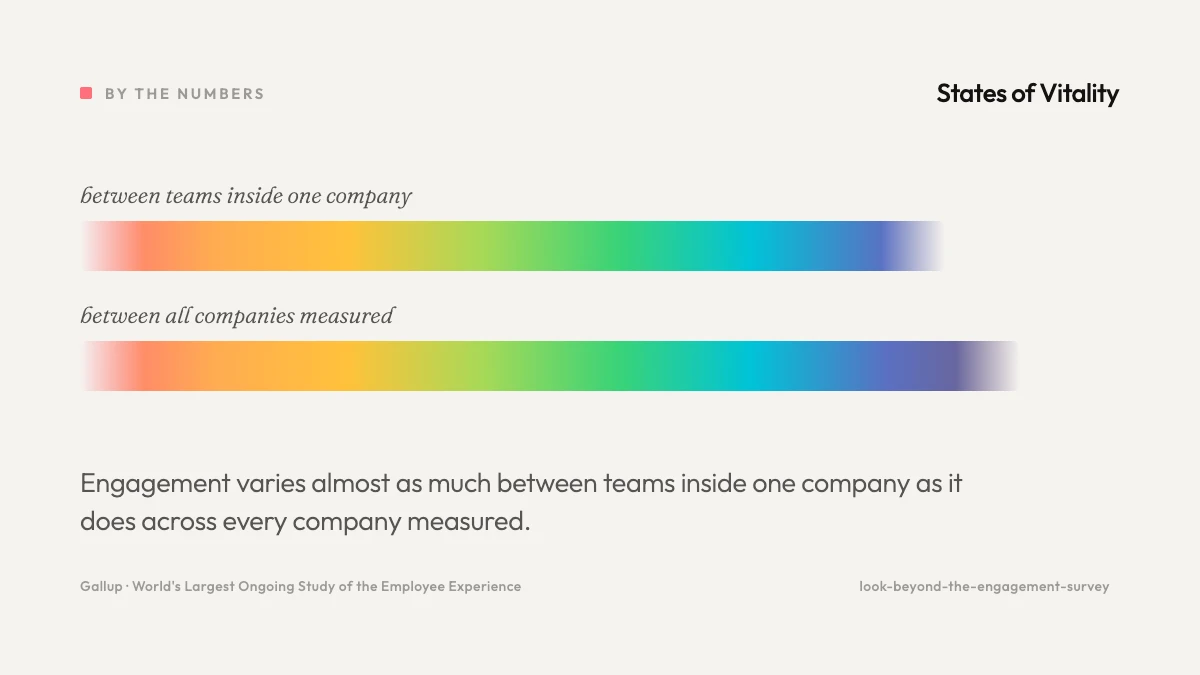
So a single company-wide score is an average laid over a landscape of difference. It's a real figure, and useful for what it is. But it's also the one that tells you least about where to look.
That isn't a fault in the survey. It's the edge of what a survey is built to see. We've looked elsewhere at how a score can give you the temperature of a place without its cause. This piece is about what lies past that edge: what an engagement survey can't tell you, and where you might look instead.
Start with what it does well
It's worth being clear about the part worth keeping, because there is one. A good engagement survey takes the temperature of a place, and it does it at scale. It tells you the level - how people, on the whole, feel about their work. It tells you the trend, if you've run it before. And it tells you, roughly, where the warmth and the chill sit: which themes lift the mood, which ones weigh on it.
That's real, and it's not nothing. A survey can catch a problem early, before it leaves the building as turnover. A theme that slips year on year is a genuine prompt to go and look. An organisation that knows its own temperature is ahead of one running on the hunch of whoever spoke loudest in the last meeting.
The strain only starts when the number is asked to be more than a reading - when the thing that tells you that something is so is also expected to tell you why, and where, and what to do about it. Those are different questions. As it turns out, they live in different places.
The number everyone watches hides the most
Start with the headline figure - the one on the opening slide, the one that travels up to the board. It's an average. And an average, by design, smooths a whole landscape down to a single point.
We've just seen how much landscape there is to smooth. A 71 built from a team that's thriving and a team that's struggling is a 71 that describes neither of them. The thriving team never hears about the rescue it didn't need. The struggling one waits for help the average says isn't warranted. The single figure has cancelled them both out.
So the first thing a survey can't tell you, on its own, is the variation it's just averaged away. We've looked at where a lot of that variation comes from - a good deal of it traces to the manager, and to the conditions a layer above them. The point here is simpler, and it's about reading rather than cause. The figure most likely to be quoted is the figure most likely to mislead, because it's one number standing in for a crowd.
You can't find a cause by ranking symptoms
So the average is thin. The natural next move is to break it open, and most survey tools will, with a technique called key-driver analysis. It looks rigorous, and it's nearly everywhere. Take each driver the survey measured - recognition, workload, clarity, and the rest. Work out which one correlates most strongly with the overall score. Present the top of that list as what to fix.
The instinct is right. The method has a ceiling. Researchers who've looked closely at key-driver analysis keep arriving at the same caution: a correlation between two answers on the same survey can't tell you which one is moving the other. Recognition and engagement rise together - but does recognition lift engagement, or do engaged people simply notice the recognition that was there all along? The ranking can't say. And the thing moving both might be something the survey never carried at all - a reorganisation, a hiring freeze, a manager spread thin across three teams. What a survey doesn't ask, it can't rank. You're left with a tidy list of things that travel alongside the score, presented as a list of things that move it. They aren't the same list.
A survey gives you a reading. It can't show you the system the reading came from.
That's the second thing a survey can't tell you: the cause. Not because it's a poor survey, but because a cause isn't the sort of thing that shows up inside a set of correlated answers. It shows up in how the parts of an organisation relate to one another - which is somewhere the survey was never looking.
What to look at instead
If the answer isn't inside the survey, where is it? In the system the survey is a reading of.
The shift is small to say and large to make: stop treating the score as the thing, and start looking at the organisation as a connected whole. Most advice at this point reaches for more readings - add a turnover figure, layer in an eNPS, run a monthly pulse, gather some open comments. All sensible. All more of the same kind of looking. More numbers about how people feel doesn't change what you're studying; it just measures it more often. A dozen readings of a feeling is still a feeling, measured a dozen ways. It isn't a picture of the thing producing it. The move that matters is from collecting readings to reading a shape.
A handful of conditions tend to shape how a place actually works - whether strategy is embedded or merely announced, whether work flows or jams, whether purpose resonates or sits in a frame by the lifts. There are eight, give or take how you cut them. But the conditions themselves are the least interesting part. The interesting part is how they connect. A cause, in an organisation, is rarely a thing sitting in one box. It's far more often a relationship between two - a strategy that never quite reaches the work, a purpose the everyday culture contradicts.
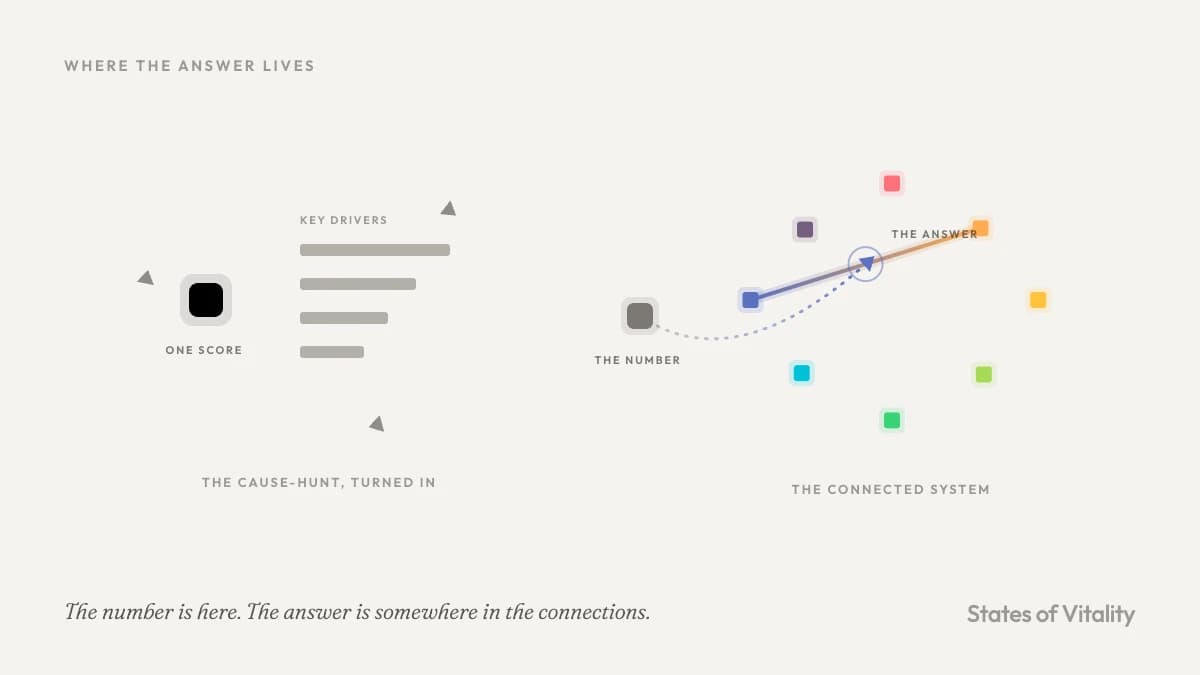
That's why a cause so rarely appears where the symptom did. The dip lands in one team's engagement, while the thing causing it sits two floors up, in the space between a strategy and the flow of work. Look at the connections, and the questions the survey couldn't answer start to have somewhere to live. Why is this team flat? becomes: what's the relationship between what we've asked of them and what we've given them to do it with? Where do we act? becomes: which connection, nudged, would move the most? Those are answerable questions. They're just not survey questions.
And they tend to point somewhere a survey rarely shines a light - the gaps between groups. The same comfortable score can sit on top of a leadership team that feels perfectly clear and a frontline that feels lost. The distance between those two readings is often where the real story is. Not in either number, but in the gap between them.
A different kind of looking
This is what an organisational assessment is for, built well: not a longer survey, but a different kind of looking. A survey samples a feeling. An assessment maps a system. It's less interested in your score than in your shape - where the organisation is strong, where it's strained, how those places connect, and where the picture for one group differs from another's. A single average can't hold any of that. A map can. It can show you that your strategy reads clearly at the top and thins on the way down, or that two departments who depend on each other trust each other least. None of that is a number you can average. All of it is a shape you can read. And because it's your own shape, it's something you can learn to read for yourselves and come back to - rather than a verdict handed down once, then carried back out of the door.
It also asks a different question. Not how do we compare against everyone else, but what's really going on in here, and where would attention pay off. Not a rank against a faceless average, but a mirror held up to your own arrangement. That, in passing, is why acting on a survey can feel like effort without traction: the sense that nothing changes often comes from pushing on the readout rather than the thing it was reading.
One honest distinction to keep. Seeing clearly and changing things are two jobs, and it helps to hold them apart. This piece is about the first - widening the view until the picture makes sense. Turning a clear picture into something that moves is the development side, and a craft of its own.
The better question
So, the next time the headline number lands - up a point, down two - and someone asks what to do, the most useful move isn't to push on the number, and it isn't to rank its drivers into a plan. It's to widen the lens. Treat the score as what it is - a reading taken at the edge of the map - and ask the better question it was pointing at all along. Not what's our number, but: what's the shape of this place, and where, in the connections between its parts, is the answer already waiting to be seen?