
An engagement survey gives you a reading - a single number for how people feel about working for you. It's a real signal, taken with care, and worth having. The trouble starts at the next step, when that reading has to become a decision.
The usual move is to slice the score by team and by question, then draw up a plan against the items that scored lowest - communication, perhaps, or recognition, or wellbeing. It feels like progress, until you notice you've chosen what to fix by which questions dipped, without ever establishing why they dipped. The plan is built on the symptom.
None of that is for want of care. The survey was designed thoughtfully, the reminders sent, the anonymity protected, the results pored over. The effort isn't the issue. The issue is that all of it produces a reading - and a reading is not yet an understanding.
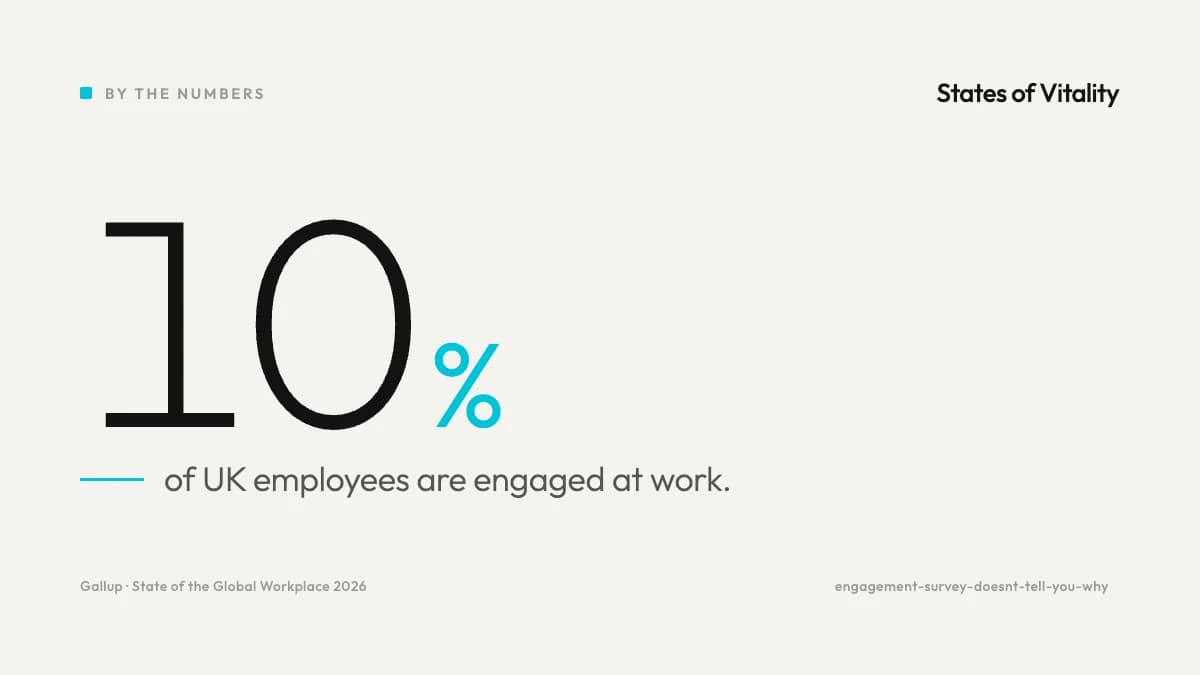
It's a common place to be. Across the UK, only about one in ten employees say they're engaged at work, by Gallup's latest count - among the lowest levels anywhere in Europe. A modest score puts you in a large room. But the difficulty isn't really the height of the figure. It's that a figure, on its own, says almost nothing about what's underneath it.
What an engagement score can and can't tell you
A thermometer is a precise instrument. Held the right way, it will tell you to a tenth of a degree that you're running a fever. What it won't tell you is whether that fever is a chest infection, a long afternoon in the sun, or a room with the heating turned up too high. The reading is accurate. It's also, by itself, not enough to act on. Nobody treats a fever by arguing with the thermometer; you treat what's causing it, once you know what that is. The reading sends you looking. It doesn't do the looking for you.
An engagement score works much the same way. It's a faithful reading of how people feel about working for you - and feeling is real, and worth knowing. But feeling is a symptom. It's the temperature, not the cause. The score registers that something is warm or cool; it doesn't tell you what's generating the heat.
Part of what makes the number so easy to over-trust is its precision. It arrives looking like an answer - 78, down from 80 - exact to the decimal, the same shape as a target. Exactness feels like clarity. But a reading can be perfectly precise and still tell you very little about its own cause. The decimal place is real. The diagnosis isn't in it.
This isn't a flaw in the survey, and it isn't a reason to stop running one. It's what a survey of this kind is built to do. The strain only shows when a single number is asked to carry more than it can. The CIPD makes the point plainly: a broad overall engagement score can flatten very different things into one figure, bundling distinct factors together until the result is hard to act on. You can see that the score has moved. You can't see which of a dozen possible reasons moved it.
Why engagement is a result, not a cause
Engagement is something an organisation produces, not something it possesses.
That's a small reframe with large consequences. We tend to talk about engagement as if it were a substance - a thing you hold more or less of, a tank to be topped up. It behaves more like an output. It's what comes out the far end when a whole set of other things are working, or aren't: whether people understand where the organisation is heading and how their own work connects to it; whether the day-to-day flows or keeps snagging; whether the culture people meet on a Tuesday morning matches the one described on the website; whether change keeps landing on the same tired teams.
Engagement sits downstream of all of that. So when the score dips, the dip isn't the problem - it's the readout of a problem that lives somewhere further up. It's why "how do we raise engagement?" so often leads nowhere satisfying. The question treats the reading as the thing to fix, when the reading is only pointing at something else. The reverse holds too. A score can sit still while everything underneath it moves; a steady number is not the same as a steady organisation.
Go looking behind a dipped score and what you tend to find is rarely "engagement" at all. It's a reorganisation that scrambled how work moves between teams. A strategy that makes complete sense in the boardroom and dissolves somewhere on its way to the front line. A set of stated values that the daily experience contradicts often enough that people have stopped believing them. None of those things will show up by name on a survey. All of them push the number down. The CIPD's own evidence review puts it carefully: measurement is a starting point, a diagnostic - what matters far more is understanding what sits behind it.
The pattern is consistent enough to be worth saying plainly. The survey reliably tells you that something is going on. It rarely tells you what, and almost never tells you where. Those last two questions - what, and where - are where the real work of understanding an organisation begins.
None of which makes the survey a waste. A temperature is useful. It's the reason you look closer. It just isn't, on its own, the thing you were trying to understand.
One number, or the whole system
Now picture the slide looking different.
Instead of one temperature, imagine eight - eight readings of the things that shape how an organisation works. How clearly the strategy shows up in the daily work. Whether the work itself has momentum or keeps stalling. Whether the service people give is sharpening or drifting. Whether there's a sense of purpose people recognise, or just a line on a wall. Whether people are growing. Whether the culture is lived or merely described. Whether the organisation's story holds together across its parts. Whether it meets change well, or keeps bracing against it.
Suddenly the same organisation reads differently. The flat number that said 78 becomes a shape - strong here, thin there, a surprising dip in one corner. And the shape is the useful part, because it points. It tells you where to look first.
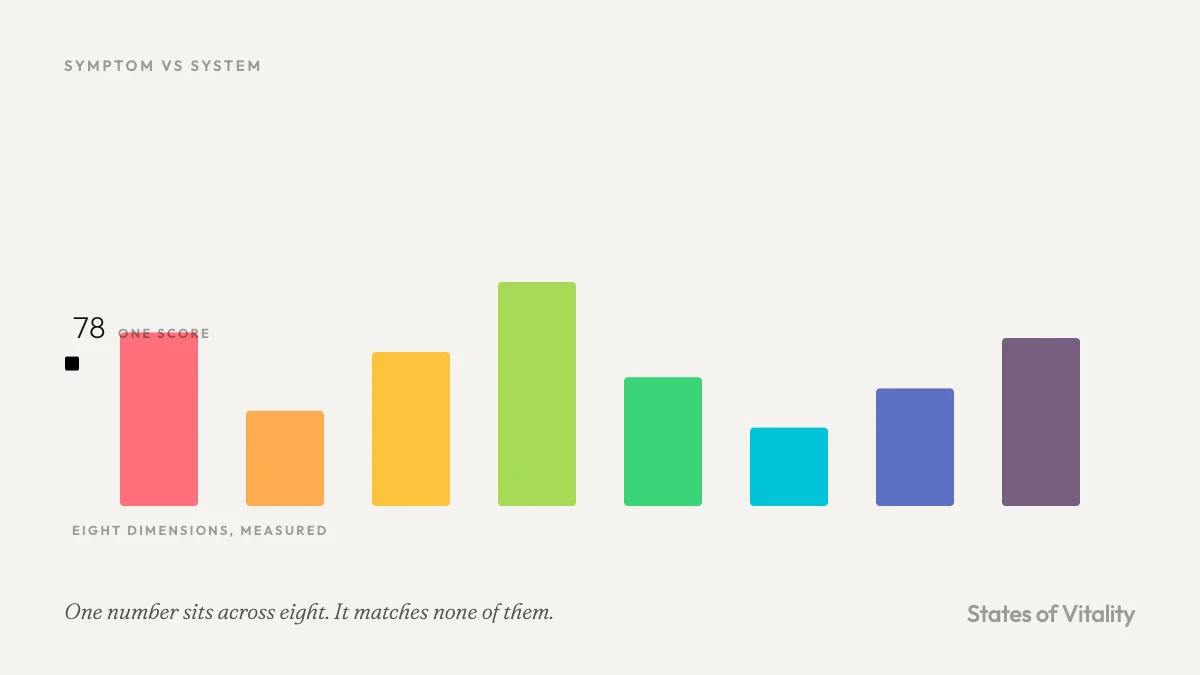
Notice what's gone, too. There's no single headline figure left to fixate on. The average was the least informative thing on the old slide - the one number guaranteed to blur every difference that mattered. Lose it, and the differences become the whole point.
This is also why a reassuring score can be misleading. Two organisations can land on almost the same number and be nowhere near the same situation. One is broadly healthy with a single sore spot. The other is straining across the board, with a couple of strong areas propping the average up. A single figure can't tell them apart. A shape can - and it would be a mistake to treat them as the same organisation simply because the headline matched.
The deeper shift, though, isn't only trading one number for eight. It's seeing how the eight connect. Strategy that's perfectly clear can still be undone by work that never quite flows. A real sense of purpose can sit awkwardly beside a culture that contradicts it day to day. A drop that surfaces in one place is often generated somewhere else entirely - which is exactly the kind of thing a flat score hides, because by the time everything has been averaged into one figure, the wiring between the parts has been averaged away too.
Picture a division whose engagement has slid for a year. On the surface the survey is clear: people feel undervalued, so the recognition score is low. The natural response is to act on precisely that - more thank-yous, a recognition scheme, a push on visibility. A season later, the number hasn't moved. The reading was accurate; the cause was somewhere else. The strategy had shifted the year before without the work shifting to match it, so people were being asked to deliver something the system no longer quite supported. What surfaced as "we don't feel valued" was nearer to "we keep being set up to fall short." Recognition was never going to reach that, because recognition was only the nearest symptom to the surface. Strategy, flow and culture were pulling on one another, and the single score could show where the strain came out - not where it began.
That wiring is the part a single engagement score can never show you: not just the signals beneath the surface, but the way they pull on each other. We map them as eight connected dimensions of organisational health - and if you want the detail of what each one covers, Mutomorro sets the framework out in full.
Holding the number more lightly
None of this is an argument against measuring engagement. Measure it - it's a real signal, and a low one is worth taking seriously. The invitation is only to hold the number a little more lightly: as the opening of a question, not the answer to one.
Because the more useful question was never "how high is our engagement?" It's "what is this telling us about everything sitting underneath it?" A score will give you the temperature. What tends to matter more is the picture of your own organisation it points toward - its particular shape, where it's strong, where the strain sits, how the parts pull on one another. Not how you compare to a benchmark of everyone else. How you, specifically, are put together.
There's a steadiness in wanting to see yourself clearly before measuring yourself against anyone else. The number tells you that you have a temperature. The more you understand the shape behind it, the better placed you are to read your own organisation - and to keep reading it, long after this particular survey has been filed away.
Seen that way, engagement stops being the thing to manage and becomes something more useful: a symptom worth following back to its source. Which raises the question the next piece takes up - if engagement is a symptom, what exactly is it a symptom of?