Ask people across an organisation how they'd rate its culture and the answer depends on where they sit. When SHRM asked exactly that - more than 17,000 employees across 19 countries - executives rated their culture good or excellent 82% of the time. Among individual contributors, the people doing the daily work, it was 47%.
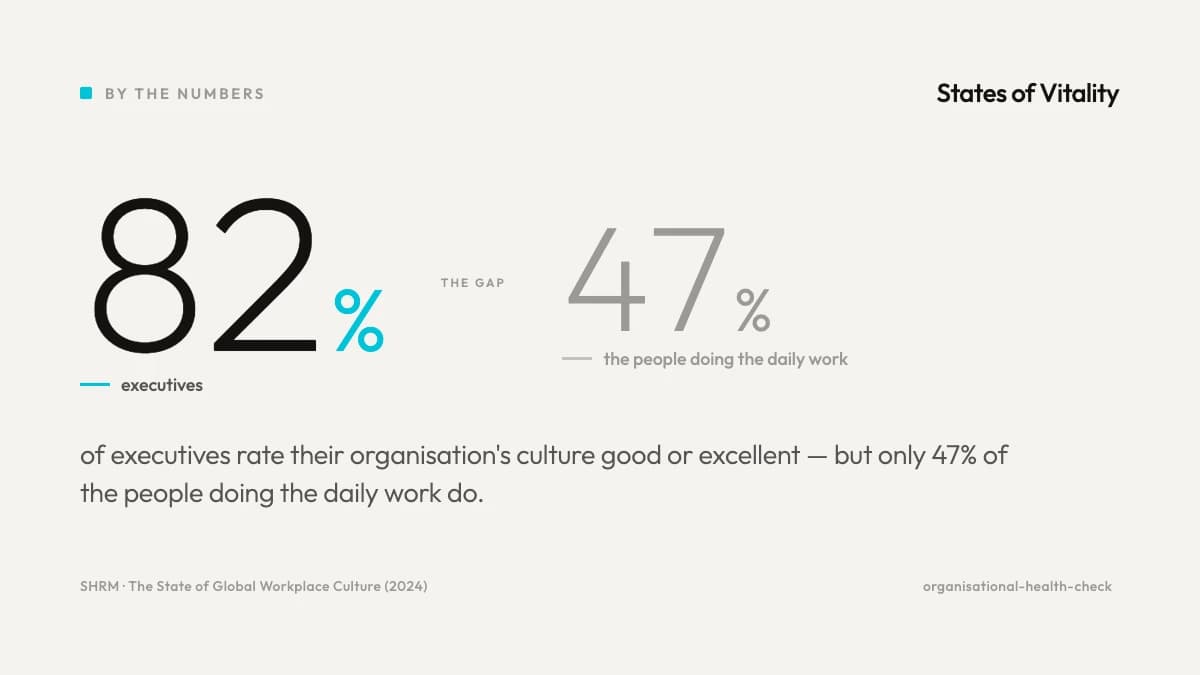
Same organisations, same cultures, two readings more than thirty points apart - decided only by the altitude of the person answering. So "where do we stand" isn't one fact waiting to be read off a gauge. It's something that looks genuinely different depending on where in the building you ask, and the higher up you go, the rosier the view tends to get.
That's the first thing any honest organisational health check has to reckon with. A reading taken only from the top is one reading. It isn't the reading. Take it from a single vantage point and you'll mistake the view from your own window for the weather outside.
This is a guide to the larger question underneath - not a checklist to run, and not a benchmark to measure up against, but a way of thinking about where your organisation really stands, what "standing" even means for something made of people, and where you might look to see it clearly.
The ruler and the mirror
There are, broadly, two ways to answer "where do we stand", and they turn out to answer rather different questions.
The first is to measure up. Take a well-built model of what a healthy organisation looks like, score yourself against it, and see how you compare with everyone else who's done the same. McKinsey's Organisational Health Index runs on exactly this logic: nine outcomes, dozens of management practices, scored against a database gathered over two decades from millions of responses, and tied to financial performance. It's a serious instrument, and the question it answers is a real one - how do we compare, and what should we copy?
Call it the ruler. It lays your organisation alongside a great many others and tells you where you fall on the scale. Health, in this view, means converging on the practices the strong performers share.
The second way asks something different. Not how do you compare, but what's going on in here - in this particular organisation, with its own history and people and tangles? Not your rank against an average, but your own shape: where your parts connect, where they pull against each other, where a little attention would travel a long way.
Call it the mirror. It doesn't lay you alongside anyone. It holds your organisation up to itself.
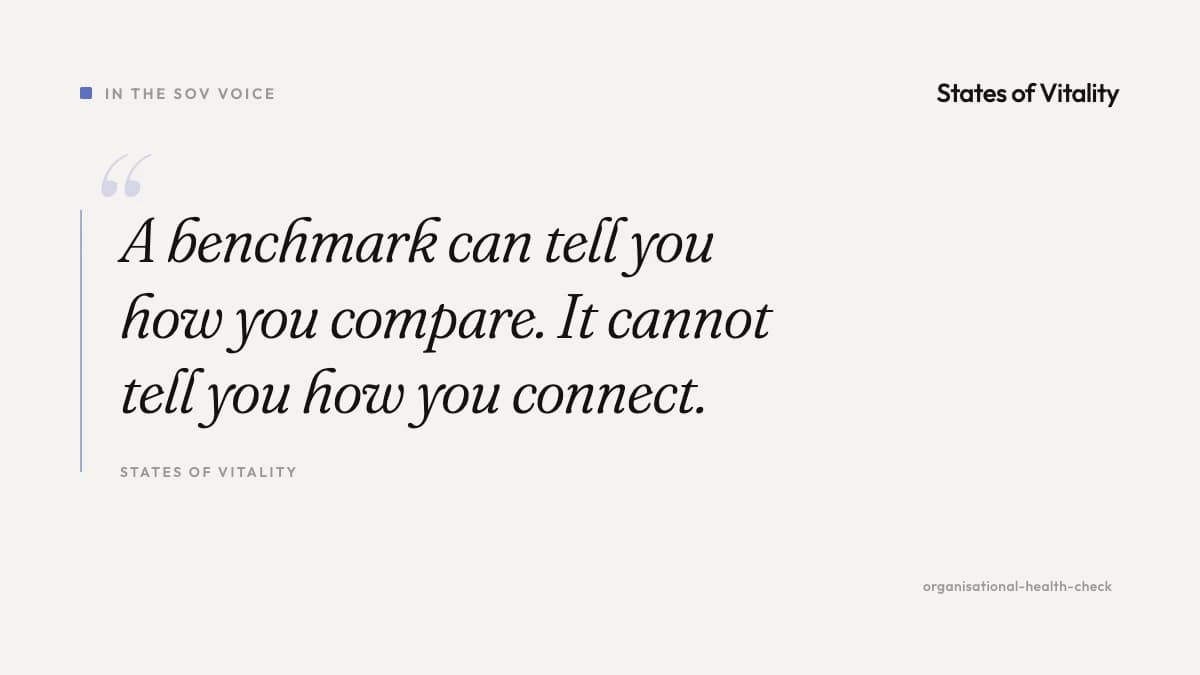
A benchmark can tell you how you compare. It cannot tell you how you connect.
Neither one is wrong, and they're not the same product at two prices. They're answers to different questions. The ruler is built for "are we doing the right things, by the standard of the field". The mirror is built for "what's true of us, specifically". A board sometimes wants the ruler, and that's fair - "how do we compare" is a genuine thing to ask. It's worth being honest that the mirror compares too. It just turns the comparison inward: how the view differs by level, by department, by how long someone's been here. Your own fault lines, rather than a faceless average. For understanding a place from the inside, that's usually the more useful comparison - and where you stand turns out to be less a rank than a shape, which is the one thing a ruler was never built to show you.
What a healthy organisation looks like - a shape, not a score
If where you stand is a shape, it helps to know what the shape is made of.
Across a good deal of work with organisations, a handful of conditions keep turning out to be the ones that decide how a place really runs. There are eight of them, give or take how you draw the lines: whether strategy is genuinely embedded or merely announced; whether work flows or stalls; whether the service the organisation exists to provide keeps evolving; whether its purpose resonates or sits in a frame by the lifts; whether it builds its own capacity to grow; whether the culture people describe matches the one they live; whether the stories that hold it together still connect; and whether it stays tuned to change or braces against it.
You could read that as a checklist - eight things to score, one row each - and a good number of assessments stop there. It's already a step on from watching a single figure. But a list, however well chosen, is the least interesting thing about a system. Lay eight conditions out in a row and what you have is a row. What gets lost is the very thing that made them a system in the first place: the connections between them.
This is where the real story lives. Strategy that's clear but never embedded slowly drains the meaning out of the work - and the work is where development happens, and development is a fair part of what a culture grows from. Tug on one and the others move. Systems thinkers have a name for the places where those connections concentrate: leverage points - spots where a small, well-aimed change shifts a great deal, while elsewhere a great deal of effort barely shifts anything. An organisation has them too, and they're rarely where the noise is loudest.
It's why two organisations with near-identical scores can feel like completely different places to work. The energy of somewhere that's genuinely working - the sense that effort goes somewhere, that people are pulling roughly the same way - doesn't sit inside any one of the eight conditions. It comes from how they meet. Which is why a place can tick every box and still feel oddly flat, and why another can be visibly short in a few places and still, somehow, hum. That emergent quality - the shape of the place rather than the sum of its scores - is its organisational vitality: the thing a single number keeps gesturing at without quite catching.
Read the gaps, not just the average
Once you're looking at a shape rather than a score, the thing worth looking at is often not any single dimension but the distance between readings.
A pattern makes that concrete. Strategy is crisp and confident at the top of an organisation, then thins as it travels down through the layers, until the people doing the work are clear enough on what to do but increasingly hazy on why it matters. The work starts to jam - nothing dramatic, just a little more friction, a few handoffs that don't quite land. Months later it surfaces as a dip in one team's numbers, often a team some distance from where the trouble began. Read that score on its own and you'd set about fixing the team. Read the shape, and you can see the strain running back to the gap between a strategy and a flow of work two floors up. The place a problem appears is frequently nowhere near the place it comes from - which is exactly how an average, or a single overall score, can mislead. It reports the symptom at full volume and leaves the cause off the page.
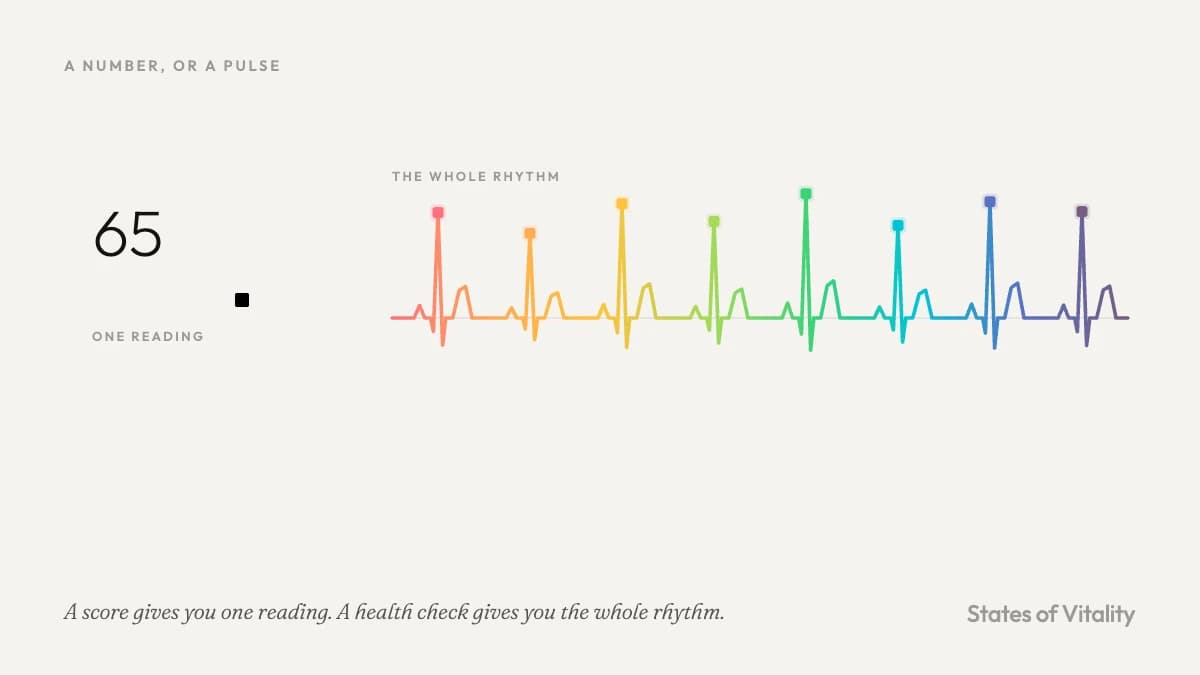
Go back to the SHRM gap - 82% against 47%, the same culture seen from two heights. An average of those numbers, somewhere around 65%, would be both true and useless. The story was never the average. The story is the gap: that the people steering and the people doing the work were describing what amounts to two different organisations. Flatten that into one figure and you've hidden the most informative thing in the data.
Gaps like that turn up all over a connected system. The distance between levels. The distance between departments that are meant to hand work to each other. The distance between the culture leadership believes it's built and the one people describe living in. Read on their own, each dimension can look fine. Read against each other, they start to show you where the system is straining - and straining where nobody's shouting about it, because nobody shouts about a gap they can't see. This is comparison, but it's yours: your own seams and pressure points, which tell you far more about how to act than a position on someone else's chart ever could.
How to assess your organisation's health
Put the pieces together and an organisational health check starts to look like something other than a test to pass.
It's a way of taking a reading of the whole shape, from more than one vantage point, paying as much attention to the connections and the gaps as to the dimensions themselves. In practice that means putting the same questions to the whole organisation rather than a slice of it, then reading the spread of the answers as carefully as their total - because the spread is where the levels and the departments and the long-serving and the newly arrived stop agreeing, and the disagreement is often the most useful thing in the room.
Plenty of organisations already take a reading of one corner of this, most often through an engagement survey - which is a real attempt to listen, and worth having. It just answers a narrower question than the one we started with. A score can give you the temperature of a place without telling you its cause; the dip that shows up in one team is often a symptom of something living somewhere else entirely; and what gets called survey fatigue is frequently the sense that answering changes nothing. A fuller health check picks up where a single instrument leaves off, and asks what the whole connected picture is trying to show.
There's a discipline in keeping the two halves apart. Reading the system clearly is one job; changing it is another, and a different kind of work. Seeing comes first, and a picture you can genuinely see is one you can afford to be patient with - the dips stop reading as verdicts and start reading as information about where to look. The work of turning that clear picture into a considered move is the development side of things, and it goes better when it's not muddled together with the seeing. A good health check shows and points. It doesn't pretend to be the cure.
That separation has a practical upside too. A reading you can take yourself, and take again, is one you keep - rather than an answer handed down once by someone outside and then carried back out of the door with them. The aim is to leave you better able to see your own organisation, not more dependent on anyone to interpret it for you.
A more useful question
The question we started with - where does your organisation really stand? - has a better version hiding inside it.
Not "how do we rank", which a ruler can answer, and which tells you mostly about everyone else. But "what's the shape of this place, and where would attention pay off" - which only a mirror can show you, and which is about no one but you. It's a question you can put to your own organisation, on your own terms, as often as it's useful to ask - taking the reading from more than one height, watching the gaps as closely as the totals, and treating the connections as the place the real story lives.
Where you stand isn't a rank. It's a shape. And the first move, before any of the changing, is simply to see it clearly.