
Across more than 27 million employee survey responses, Qualtrics went looking for the one question whose answer best separated the healthiest organisations from the rest. Not engagement. Not pay, not workload, not trust in leadership. The item that did the most work was this: I believe that positive change will happen as a result of this survey.
So the strongest single marker of a thriving place isn't what people make of the work - it's whether they believe the asking leads anywhere. Which casts a familiar complaint in a different light. When people say they're tired of surveys, the problem usually isn't the asking. It's the silence on the other side of it.
Surveys are, at heart, an act of listening - a standing invitation that says your view matters here, so tell us. When engagement with them fades, the usual diagnosis is survey fatigue: people have tired of being asked. The housekeeping that points to is worth doing - fewer surveys, shorter ones, better spaced. But listen to what people actually say, and something more specific shows up.
Listen to what people actually say
Ask someone why they left the last survey unopened and you rarely hear "it was too long." Far more often it's a version of the same flat line: what's the point - nothing ever changes.
That's not fatigue with the asking. It's more specific, and more telling - the sense that answering leads nowhere, that the feedback goes up and over a wall and the wall stays exactly where it was. The weariness is real. It just isn't weariness with the questions. It's weariness with the silence that follows them.
The scale of that silence is easy to underestimate. Qualtrics found that 92% of employees say feedback matters to them - the wish to be asked is close to universal. In the same study, only 7% said their organisation acts on the feedback they give.
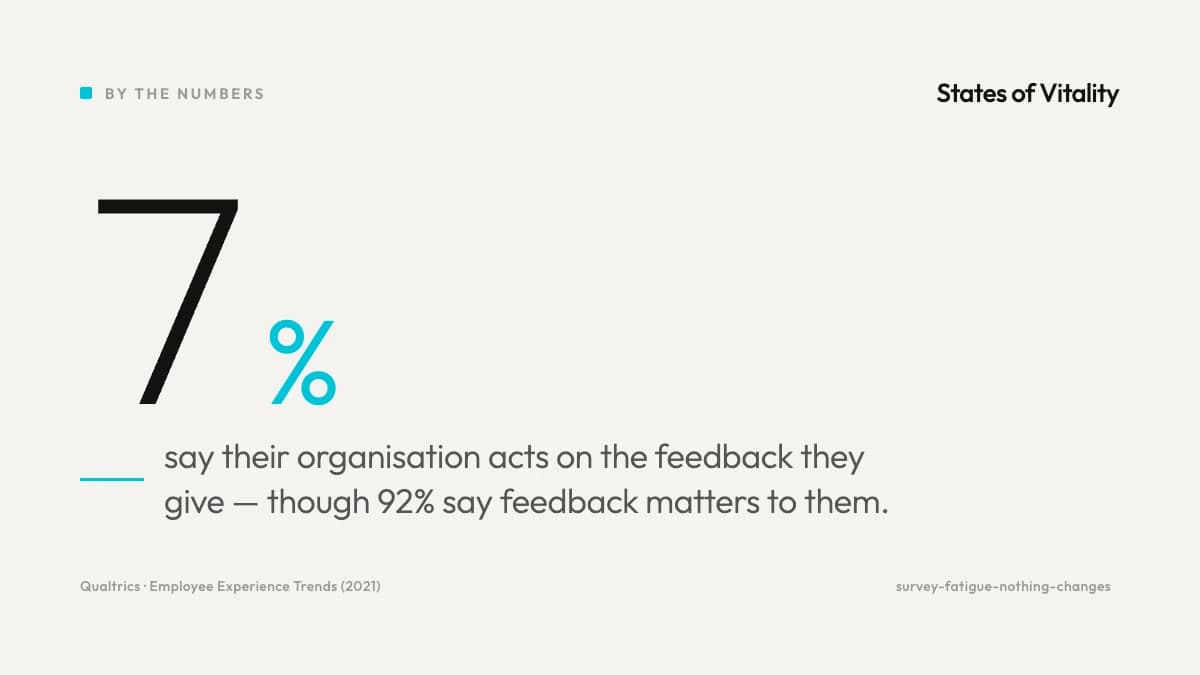
Sit with that gap, because it rearranges the problem. People haven't gone quiet because they're sick of being consulted - the appetite to be heard is overwhelmingly there. What's thinned out is the answering-back. What we file under survey fatigue is, for a lot of people, that gap made personal: the slow accumulation of having spoken into a room and watched nothing come of it.
There's a small unspoken promise inside every survey, too. You don't ask a question unless there's at least a chance you'll act on the answer. So each round of asking holds out an undertaking - tell us, and it'll matter - and each round that passes without anything shifting lets a little of that go unmet. Do it often enough and the asking starts to read as hollow. Which is why being surveyed and then ignored can wear on people in a way that never being asked at all doesn't.
It is not the asking that tires people, but the silence that follows it.
Why acting on a survey so often changes nothing
So why does the silence persist? Not for any lack of trying. Organisations full of capable, well-meaning people go on asking, go on intending to act - and still the belief that it matters drains away.
Some of it is ordinary. Results land, a crowded quarter swallows them whole, and the next survey is in the field before the last one's promises were kept. The standard advice meets exactly this, and it's good as far as it reaches: close the loop, act where you can, tell people plainly what changed and why. Anyone who's run a listening programme knows the discipline that takes, and how easily it slips.
But there's a deeper reason nothing seems to change, and it's the one that ties survey fatigue to everything around it. It's the thread we've pulled on before: a survey reads a symptom, not its source.
Picture how the acting usually goes. The wellbeing scores dip, so a wellbeing programme gets bolted on. One team's numbers slide, so that team's manager is booked onto a course. The action lands precisely where the figure moved - which feels like common sense, and is often beside the point. Because the place a problem surfaces in a survey is frequently nowhere near the place it's coming from. A score gives you the temperature, not the cause, and a low reading in one corner can trace back to something seizing up two floors away - a strategy that never quite embedded, a flow of work that jams for reasons no team on its own can see. Push on the reading and it might even budge for a while. The condition underneath carries on regardless.
So a strange thing happens. The organisation does act. It acts in good faith, sometimes at real expense, often with real care. And still, to the people who answered, nothing changes - because the thing troubling them lived somewhere the action never reached. This is rarely a failure of effort, or of goodwill. It's a failure of aim. The nothing-changes feeling isn't always cynicism. A fair amount of the time it's an uncomfortably accurate read of effort aimed at the wrong place.
The loop that looks closed but isn't
There's a diagram every engagement programme draws, much the same one each time: survey, then results, then an action plan, then back round to the next survey. A tidy circle. Close the loop, the phrase goes.
The trouble is that the loop only closes on paper. The action plugs into the symptom - the score that moved - while the cause sits off in another part of the system, untouched and unmentioned. So the circle turns over perfectly well and the organisation barely shifts. Effort goes in, a plan comes out, the underlying shape of the place is exactly as it was, and round it comes again next quarter. To the people inside it, that's not a loop closing. It's a loop spinning.
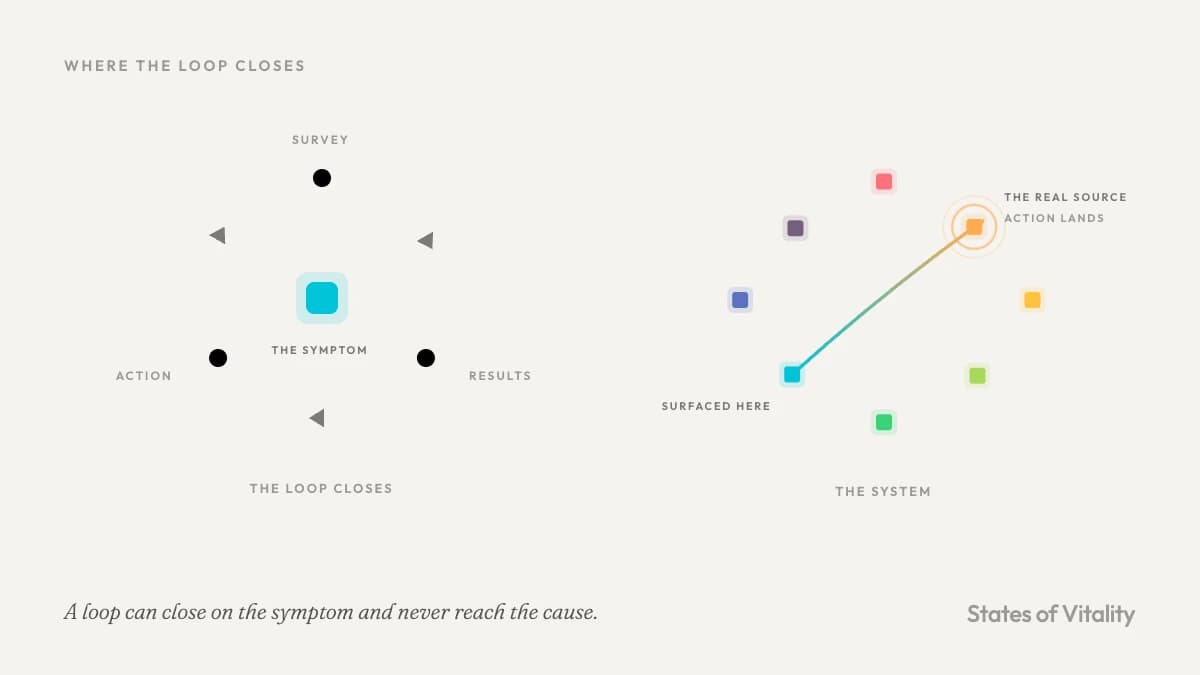
A loop that moves something has to close somewhere else. It has to read the organisation as a connected whole - the handful of conditions that shape how a place works, and the way each pulls on the others - so that when a signal shows up in one corner, you can follow it back to where it's coming from, and act there instead. That's a different motion altogether. Less closing a loop on a number, more following a thread through a system until it reaches the knot.
A falling response rate is feedback too
Watch what repetition does to all this. Each round of being asked and seeing nothing follow teaches a small, durable lesson: answering isn't worth the effort. Run that lesson often enough and people learn it well. Qualtrics' more recent work puts it plainly - listening that's never followed by visible action doesn't leave people neutral, it breeds cynicism. The asking begins to cost you something precisely because nothing comes after it.
You can watch the belief drain away in the figures, if you keep them long enough. One UK public body's staff survey tracked the share of people who thought action would be taken on the results, year on year, and it slid from 35% to 24% across a handful of surveys. That's not a workforce that got tired of clicking. That's a workforce that learned.
Which turns the opening diagnosis on its head. The dropping response rate written off as fatigue is rarely apathy. It's a learned response to a pattern people have read correctly - and it's some of the most honest feedback the survey has ever collected. The belief that finding at the top calls the strongest marker of a healthy place - whether people think answering leads anywhere - the survey hands you back for free, every time, in the response rate nobody wanted to look at too closely. When the answer to "will this matter?" has come back "no" enough times, not answering is the rational move. The silence is the message.
From fixing the survey to reading the system
The name we give a problem decides where we go looking for the fix. Call it survey fatigue and the hand reaches for survey hygiene - fewer, shorter, better spaced. All worth doing, and none of it touches the thing underneath.
Call it what it more often is - the felt sense that answering changes nothing - and it points somewhere more useful. Not at the survey at all, but at why the acting keeps missing. And that's a question about the organisation as a system, not about the instrument you happen to be measuring it with. There's an irony in it: the survey's most useful answer turns out not to be about the work at all, but about whether people trust the asking to go anywhere. Read that honestly and you're already looking at the system rather than the form. The work of turning a clear picture into change that lands where the cause lives is squarely the development side of things.
For now, the smallest useful move is also the kindest. The next time engagement with a survey slips - fewer replies, or flatter ones, or that what's-the-point in the comments - and someone reaches for the word fatigue, it's worth a pause before reaching for the form. Worth asking instead what people have learned about whether answering is worth their while - and whether the last round of action ever landed within sight of what was actually wrong. The dip might not be people tuning out at all. It might be the truest thing the survey has told you all year.